Device-Level Defense Against SS7-Based Mobile Network Threats
A mobile threat verification and rogue base station detection platform designed for national security, critical infrastructure, and government communications.
Deployed as a controlled capability for government, defense, and critical infrastructure programs.
Strategic Context
The SS7 Risk Surface
The Signaling System No. 7 (SS7) protocol underpins global mobile communications. It was designed for a trust-based environment that no longer exists.
Legacy Signaling, Modern Threats
SS7 was designed in 1975, without cryptographic authentication and under a trusted-operator assumption. Its design prioritized interoperability and reachability, not adversarial resilience.
- Plain-text signaling between operators
- No mutual authentication between core elements
- Limited native integrity controls
Persistent in 4G / 5G Environments
Despite newer protocols, SS7 remains active in global roaming, interconnect, and fall-back paths. Adversaries continue to leverage SS7 pathways even in nominally modern networks.
- 4G/5G roaming still traverses SS7 segments
- Legacy interconnects remain exposed
- Attack surfaces extend beyond national borders
Operational Consequences
Weak signaling controls enable strategic exploitation of subscriber signaling, location, and messaging channels at scale.
- Location tracking across territories
- SMS interception and manipulation
- Forced downgrade and session disruption
National Security Impact
Critical Infrastructure Exposure
SS7 vulnerabilities extend beyond telecommunications. They create cross-domain exposure for government communications, critical infrastructure operators, and regulated industries.
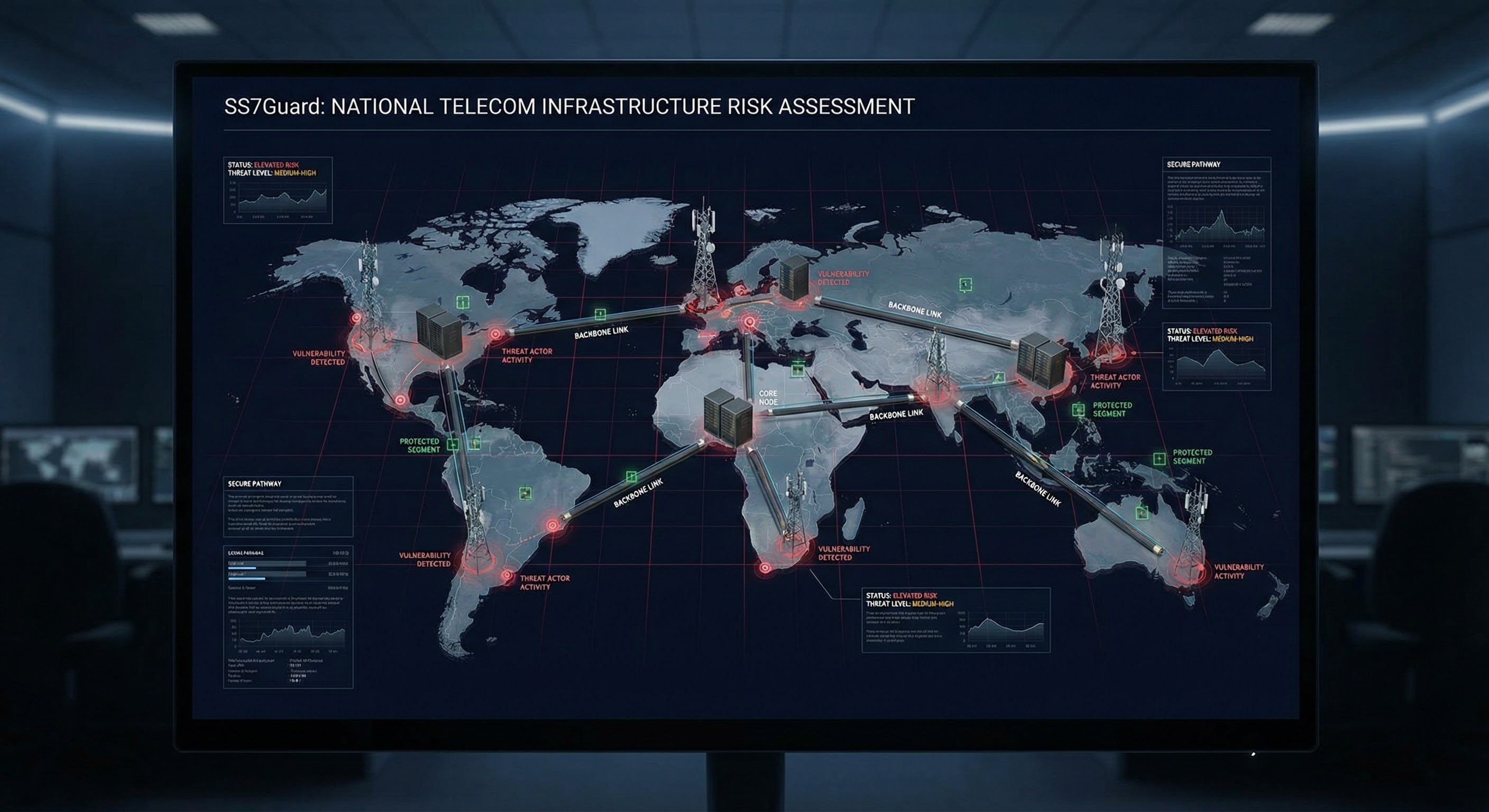
This representation follows a national-level threat assessment structure. It is designed to support classified annexes, executive briefings, and inter-agency coordination documents.
SS7Guard Platform
Operator-Independent Mobile Threat Verification Layer
SS7Guard provides a device-level verification layer that operates independently of mobile network operators, creating a defensive control point directly on authorized devices.
Global SS7 Activity
Real-Time Threat Surface View (Simulated)
This panel provides a continuous, simulated view of SS7-related activity across regions, aligned with the SS7Guard threat model. It is designed for briefing and demonstration purposes and does not display live classified telemetry.
Technical Architecture
Layered Defense Model
SS7Guard is structured as a layered defense system, from the device to central intelligence pools, with clearly defined responsibilities at each layer.
-
Layer 1 – Mobile Client IntelligenceOn-device monitoring of cell identity, signaling behavior, and network parameters with tamper-aware controls.
-
Layer 2 – Signal Behavior Analysis EngineLocal analysis of handovers, paging, location updates, and SS7-related events to identify abnormal patterns.
-
Layer 3 – AI Risk Scoring SystemModel-driven evaluation of observed behavior with contextual factors such as geography, time, and historical baselines.
-
Layer 4 – Secure API VerificationMutual-authenticated communication with central verification services over hardened channels for high-confidence decisions.
-
Layer 5 – Central Threat Intelligence PoolAggregated and curated intelligence on signaling anomalies, rogue infrastructure, and known hostile patterns.
-
Layer 6 – Forensic Logging & Reporting ModuleStructured reporting interface for incident reconstruction, compliance documentation, and inter-agency sharing.
Regulatory & Governance
Regulatory Alignment & Compliance Readiness
SS7Guard is designed to align with prevailing data protection, national security, and critical infrastructure governance frameworks.
GDPR & KVKK
Supports data minimization, purpose limitation, and secure processing principles under GDPR and KVKK regimes, with configurable retention policies and pseudonymization options.
ISO 27001 Alignment
Integrates with information security management systems, providing auditable controls, logging, and incident evidence to support ISO 27001-certified environments.
Critical Infrastructure Standards
Designed for operators classified as critical infrastructure, supporting network-level resilience and signaling-layer situational awareness.
Government Data Protection Frameworks
Enables deployment within sovereign environments and government-operated clouds, with options for full national data residency.
A detailed compliance mapping and control catalogue is available as part of the confidential technical documentation set for competent authorities and accredited auditors.
Deployment Focus
Target Institutions
SS7Guard is intended for controlled deployment within state, regulatory, and critical infrastructure environments.
Ministries of Defense
Protection of command, control, and defense communications from signaling-layer exploitation.
Interior Ministries
Secure mobile communications for internal security, border, and emergency management operations.
National Telecom Regulators
Independent verification of operator security posture and cross-border signaling exposures.
Law Enforcement Agencies
Hardened devices for investigative, protective, and operational units with elevated threat exposure.
Critical Infrastructure Operators
Defensive coverage for energy, transport, finance, and other strategically significant sectors.
State-owned Telecom Providers
On-device verification layer complementing network-side signaling firewalls and controls.
Strategic Positioning
Containing SS7 Risk at the Device Level
"SS7 cannot be replaced immediately.
But its risks can be contained.
SS7Guard establishes the first defensive line at the device level."
Confidential Technical Documentation Available Upon Request